
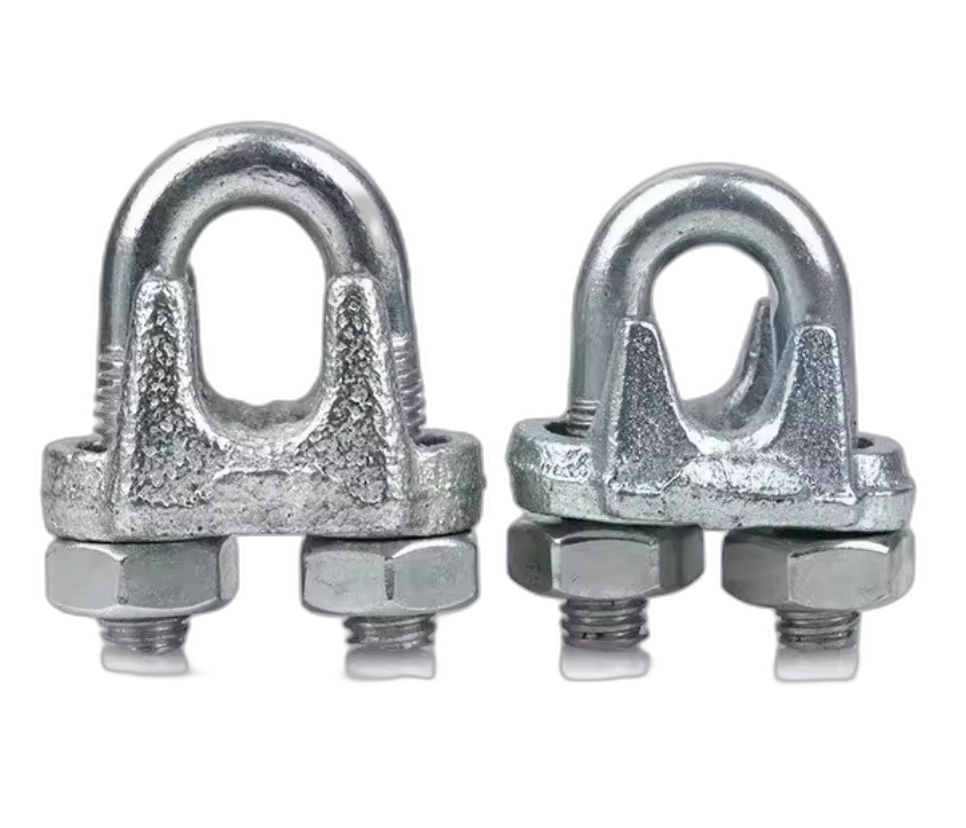
Wire rope clips (also called cable clamps or U-bolt clips) are used to form eyes in wire rope or to connect two ropes together. Proper installation is critical — a failed clip can drop a load. We compared the 3 most common brands used in construction and rigging.
Comparison: 1/2″ Wire Rope Clips
| Feature | Crosby G-450 | Chicago Hardware | Campbell |
|---|---|---|---|
| Rating | ⭐ 4.8/5 | ⭐ 4.5/5 | ⭐ 4.3/5 |
| Type | Forged steel, hot-dip galvanized | Drop-forged, zinc plated | Drop-forged, zinc plated |
| Design | Wide saddle, deep U-bolt | Standard saddle | Standard saddle |
| Torque Marking | • Stamped on clip | • Reference chart | • Reference chart |
| Efficiency | 80% (3 clips) | 80% (3 clips) | 80% (3 clips) |
| Price (box of 10) | $45–$65 | $25–$35 | $20–$30 |
| Origin | ?? USA | ?? USA | ?? USA |
| Standards | FF-C-450 Type 1 Class 1 | FF-C-450 | FF-C-450 |
Brand Reviews
Crosby G-450 — The Only Choice for Critical Lifts
⭐ 4.8/5 | When lives are on the line, riggers reach for Crosby. The G-450 features a wider saddle that distributes load better, a deeper U-bolt for proper engagement, and — crucially — the recommended torque value stamped directly on each clip. No guessing, no looking up charts on a windy crane platform.
What riggers say: “Never saddle a dead horse, and never use anything but Crosby. That’s what my foreman taught me day one.” — Journeyman ironworker
Pros: • Torque value stamped on clip • Superior forging quality • Wider saddle = less rope damage • Individual lot traceability
Cons: • 2× the price of competitors
Chicago Hardware — Solid Mid-Range
⭐ 4.5/5 | A Chicago-area manufacturer with a long history in rigging hardware. Their clips are well-made and properly spec’d. A good choice for general industrial use where Crosby’s premium isn’t justified.
Pros: • Good quality at fair price • American-made • Consistent sizing
Cons: • No torque marking on clip • Zinc plating less durable than hot-dip galvanizing
Campbell — Budget Standard
⭐ 4.3/5 | Widely available at hardware stores and home improvement centers. Fine for non-critical applications like guy wires, fencing, and general utility use. Not recommended for overhead lifting.
Pros: • Cheapest option • Easy to find locally
Cons: • Inconsistent quality reported • Saddle dimensions can vary • Not recommended for critical lifts
Installation Matters More Than Brand
Even the best clip fails if installed wrong. The golden rule:
“Never saddle a dead horse” — the saddle (curved part) goes on the live (load-bearing) end, the U-bolt goes on the dead (tail) end.
Key installation points:
• Use the correct number of clips (3 for 1/2″ rope, 4 for 3/4″, 5 for 1″)
• Space clips 6 rope diameters apart
• Torque to manufacturer’s spec
• Re-torque after first load application
• Turn back (tail) length: minimum 6 inches
Recommendation
Overhead lifting / critical applications: Crosby G-450, no exceptions. General industrial: Chicago Hardware — good quality, fair price. Non-structural / utility: Campbell — adequate for fencing, guy wires, and similar.
Ratings from rigger forums, ASME inspection data, and industrial distributor surveys. CargoRigging.com is an independent directory.
Looking for trusted suppliers?
Frequently Asked Questions
How many wire rope clips do I need for a secure termination?
The number depends on the rope diameter per the Crosby ‘Number of Clips’ table: 3 clips for 1/4 to 5/8 inch rope, 4 clips for 3/4 to 7/8 inch, 5 clips for 1 to 1-1/8 inch, and 6 clips for 1-1/4 to 1-1/2 inch. Spacing between clips should equal 6 times the rope diameter. Using fewer clips than specified reduces the termination efficiency below the required 80% of rope breaking strength.
What is the correct orientation for installing wire rope clips?
The saddle (U-bolt base) goes on the live (load-bearing) end, and the U-bolt goes on the dead (tail) end. Remember the rule: ‘Never saddle a dead horse’ — the saddle always rides on the live rope. Incorrect installation (saddle on dead end) reduces the termination efficiency from 80% to approximately 40%, cutting your capacity in half. After initial loading, re-torque all clips to the manufacturer’s specification.
Can I reuse wire rope clips after removing them?
Yes, wire rope clips can be reused if they pass visual inspection — check for thread damage, cracks in the saddle, and deformation of the U-bolt. However, the wire rope inside the clip is permanently deformed after clamping and should be re-cut at the old clip marks before re-terminating. Never reuse clips that show corrosion pitting, elongated bolt holes, or stripped threads. Replace the nuts with new ones if they show any resistance during threading.
Products Featured in This Review

Crosby — Crosby Drop Forged Wire Rope Clip, Galvanized, 9/16″ – 5/8″ Wire Rope Size, G-450
Check Price on AmazonAlso featured in this review:
Chicago Hardware on AmazonAs an Amazon Associate, CargoRigging.com earns from qualifying purchases.