
Lumber Loads Kill People Every Year
Unsecured lumber on a trailer is not a minor inconvenience — it is a deadly hazard. Lumber that shifts or falls off a trailer at highway speed becomes a projectile. A single 2×4 that flies off a truck can pierce a windshield. A bundle of plywood that slides off a flatbed can cause a multi-vehicle pileup.
The FMCSA and DOT take lumber securement seriously. Violations result in fines of $1,000–$16,000 per offense, and if an unsecured load causes an accident, the driver and carrier face criminal liability.
This guide covers how to secure lumber correctly for both commercial and personal hauling.
Equipment Needed
| Item | Specification | Quantity |
|---|---|---|
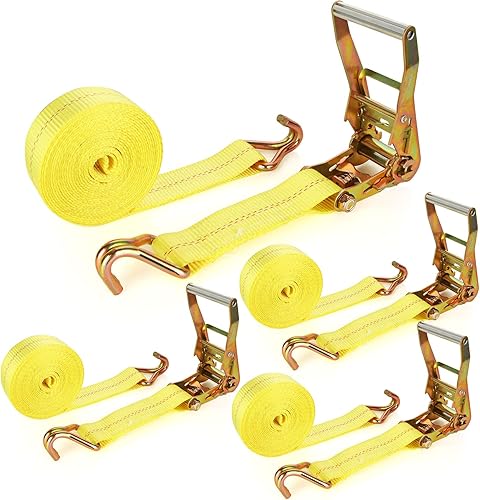
| Ratchet straps | 2″ or 4″ wide, 3,300–5,400 lb WLL | 3–6 (depends on load length) |
| Edge protectors | Plastic or rubber, fits 2″–4″ straps | 2 per strap (both edges) |
| Lumber stakes or side boards | Steel or wood, rated for load weight | 4–8 |
| Dunnage (spacer boards) | 4×4 lumber, 3’–4′ long | 3–6 |
| Anti-slip mats (optional) | Rubber, 12″ x 12″ or larger | 4–6 |
Step-by-Step: Securing a Lumber Stack
Step 1: Prepare the Trailer Bed
Lay dunnage boards (4x4s) across the trailer bed perpendicular to the load direction. Space them every 4–5 feet. Dunnage serves three purposes: it keeps the lumber off the wet trailer bed (preventing water damage), it allows forklift access for unloading, and it provides a flat, stable base.
For extra grip, place anti-slip rubber mats on top of the dunnage before loading the lumber.
Step 2: Stack the Lumber
Stack lumber flat and level. Wider boards go on the bottom, narrower on top. Each layer should be the same length — don’t mix 8-foot and 12-foot boards in the same stack unless the shorter boards are centered and contained by longer boards below.
Maximum stack height: The top of the lumber stack should not exceed the height of the trailer stakes or side boards. If it does, the stakes cannot prevent lateral shift.
Step 3: Apply Straps with Edge Protectors
Run ratchet straps over the top of the lumber stack and down to the trailer tie-down points. Before tightening, place edge protectors at every point where the strap contacts a sharp edge — the top corners of the stack and any intermediate edges.
Without edge protectors, the sharp 90-degree corner of dimensional lumber will cut through polyester webbing under tension. This is not a maybe — it is a certainty on any trip over 20 miles.
Step 4: Strap Spacing
FMCSA rules require one tie-down for every 10 feet of cargo length, with a minimum of two tie-downs for any load. For lumber specifically:
| Lumber Length | Minimum Straps | Recommended Straps |
|---|---|---|
| 8 feet or less | 2 | 3 |
| 8–16 feet | 3 | 4 |
| 16–24 feet | 4 | 5–6 |
| Over 24 feet | 4+ (1 per 10′) | 6+ |
Place the first and last straps within 2 feet of the ends of the lumber stack. Space remaining straps evenly between them.
Step 5: Check for Lateral and Longitudinal Restraint
Vertical straps hold the lumber down, but you also need to prevent it from sliding forward (during braking) and sideways (during turns). Stakes or side boards provide lateral restraint. A header board or front rack provides forward restraint.
If your trailer has no stakes, you must rely entirely on straps for all three axes — which means you need more straps and better angles. Consider adding at least two diagonal straps that angle from the front of the load to rear anchor points.
Plywood and Sheet Goods
Plywood, OSB, drywall, and other sheet goods present a unique challenge: they act as sails. A 4×8 sheet of plywood at 60 mph generates enormous wind lift. Stacked flat, they’re manageable. But if a top sheet works loose, the wind catches it and it becomes airborne.
How to Secure Sheet Goods
- Stack flat, never on edge. Sheets stacked on edge will topple. Always lay them flat.
- Weight the top. Place heavier dimensional lumber on top of sheet goods to prevent wind lift.
- Use a tarp. A fitted tarp over the top of the stack prevents wind from getting under the top sheets. Secure the tarp with its own straps or bungees.
- Strap every 4 feet. Sheet goods are more susceptible to wind than dimensional lumber. Use more straps than you think you need.
Long Lumber (Over 16 Feet)
Boards longer than the trailer bed create overhang issues. DOT allows up to 3 feet of rear overhang for personal vehicles and up to 4 feet for commercial vehicles without a flag. Beyond that:
- Over 4 feet overhang: Requires a red flag or cloth (18″ x 18″ minimum) during the day, and a red light at night.
- Overhang beyond the trailer width: Not allowed. Lumber must not extend beyond the sides of the trailer.
For very long lumber (20+ feet), use a pole trailer or extend the wheelbase with a reach extender. Strapping long lumber to a short trailer creates a lever arm that magnifies every bump and turn.
Common Mistakes
1. No Edge Protectors
The number-one cause of strap failure on lumber loads. A 2″ strap under 1,000 lbs of tension against a sharp pine edge will cut in under 50 miles. Edge protectors cost $2 each. Use them.
2. Mixed Lengths Without Containment
Mixing 8-foot and 12-foot boards in the same stack allows the shorter boards to slide out during braking. If you must mix lengths, place shorter boards in the center of the stack (not on the ends) and add an extra strap at the transition point.
3. Relying on Gravity Alone
Heavy lumber stacks feel stable sitting still. But at 60 mph, wind forces, vibration, and cornering G-forces are constantly working to shift the load. Every lumber load needs positive restraint — straps, chains, or binders — regardless of weight.
4. Wet Lumber on Smooth Trailers
Wet lumber on a steel or aluminum trailer deck has almost zero friction. The stack will slide forward during the first hard brake. Use anti-slip mats, dunnage with rubber surfaces, or chains for wet lumber loads.
DOT Inspection Points
During a roadside inspection, officers check these specific items for lumber loads:
- Number of tie-downs vs. load length (the ratio described above)
- Edge protectors at every strap-to-lumber contact point
- Strap condition (no cuts, fraying, or knots)
- Stack height vs. stake height (load must not exceed stakes)
- Overhang flags or lights if required
- Combined WLL of all tie-downs vs. 50% of cargo weight
Related Articles
- What Size Ratchet Strap You Need
- Dot Cargo Securement Regulations
- Flatbed Tie-Down Methods
- Edge Protection For Cargo Securement
- How To Tie Down A Car On A Trailer
Frequently Asked Questions
Do I need edge protectors for ratchet straps on lumber?
Yes, absolutely. Dimensional lumber has sharp 90-degree edges that will cut through polyester webbing under tension. Edge protectors (also called corner protectors) are required by FMCSA regulations for any tie-down that contacts a sharp edge. They cost about $2 each and prevent strap failure that could release your entire load.
How many straps do I need for a load of lumber?
At minimum, two straps for loads under 10 feet, plus one additional strap for every 10 feet of length. A 20-foot lumber load needs at least four straps. Place the first and last straps within 2 feet of the ends, and space the rest evenly. When in doubt, add more — extra straps provide redundancy if one fails.
Can I use chains instead of straps for lumber?
Yes, but chains are typically used only for very heavy bundles of treated lumber, green lumber, or engineered wood products. Chains won’t cut on sharp edges like straps will, and they have higher WLL per unit. However, chains can damage and dent lumber surfaces, so they’re better suited for construction-grade material than finished wood. For most personal and light commercial hauling, straps with edge protectors are preferred.
How far can lumber hang off the back of a trailer?
DOT allows up to 3 feet of rear overhang without any marking for personal vehicles. Commercial vehicles can extend up to 4 feet without marking. Beyond these limits, you must display an 18″ x 18″ red flag during the day or a red light at night. Maximum legal overhang varies by state but is typically 10–15 feet for commercial loads with proper marking and permits.
⭐ Recommended Products

As an Amazon Associate, CargoRigging.com earns from qualifying purchases.