
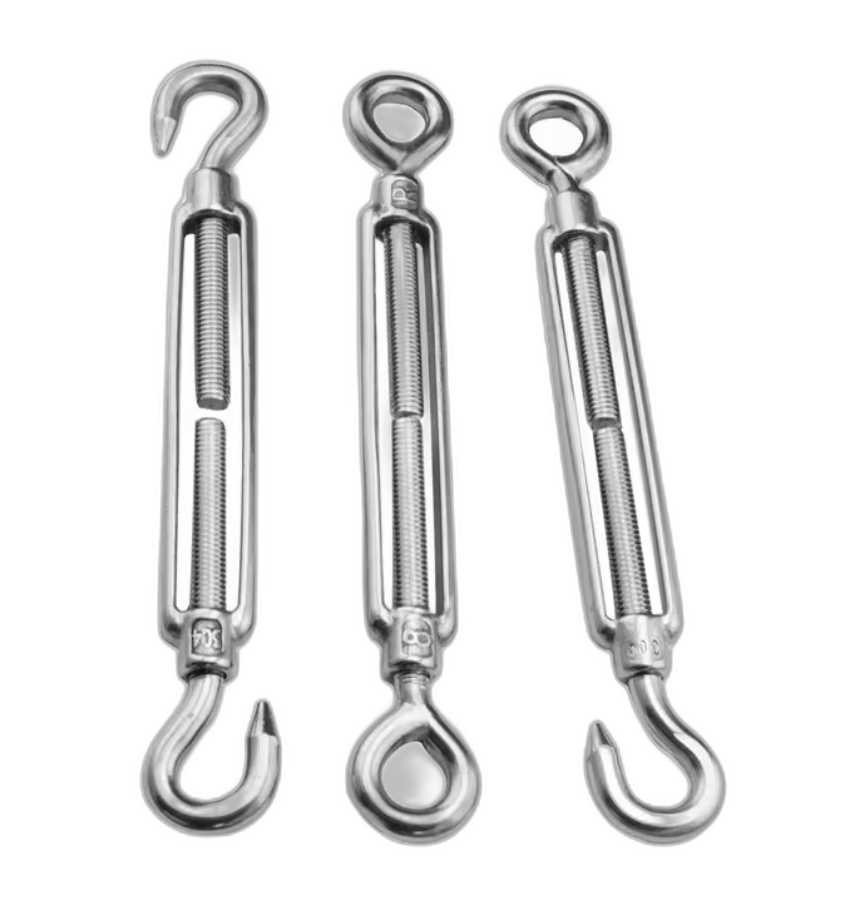
Turnbuckles are used to adjust tension in wire rope, cables, and rod assemblies. From stage rigging to sailboat stays to structural bracing — they’re everywhere. We compared 3 brands in the 1/2″ jaw-jaw style, the most common configuration.
Head-to-Head: 1/2″ Jaw & Jaw Turnbuckles
| Feature | Crosby HG-228 | Chicago Hardware | E-Rigging |
|---|---|---|---|
| Rating | ⭐ 4.8/5 | ⭐ 4.5/5 | ⭐ 4.2/5 |
| WLL | 2,200 lbs | 2,200 lbs | 2,200 lbs |
| Material | Forged steel, galvanized | Drop-forged, zinc plated | Drop-forged, zinc plated |
| Take-Up | 6″ | 6″ | 6″ |
| Body Style | Open body | Open body | Open body |
| Thread Type | Right-left hand UNC | Right-left hand UNC | Right-left hand UNC |
| Proof Tested | • 2× WLL | • 2× WLL | • 2× WLL |
| Price (each) | $18–$28 | $12–$18 | $6–$10 |
| Origin | ?? USA | ?? USA | ?? China |
Brand Reviews
Crosby HG-228 — When It Absolutely Has to Hold
⭐ 4.8/5 | Crosby turnbuckles feature superior forging, hot-dip galvanizing (vs zinc plating), and individual proof test certificates. The thread engagement is smooth and consistent — important when you’re adjusting tension 30 feet in the air on a scaffold.
Pros: • Hot-dip galvanized (superior corrosion resistance) • Smoothest thread engagement • Individual proof test cert • Crosby reputation
Cons: • 2-3× the price of imports • Can be hard to find in small quantities
Chicago Hardware — Best Value American-Made
⭐ 4.5/5 | A solid, American-made turnbuckle at a fair price. The zinc plating is adequate for indoor and mild outdoor use. A good choice when you need quality without Crosby’s premium.
Pros: • American-made • Good quality • 40% cheaper than Crosby
Cons: • Zinc plating (less corrosion protection than hot-dip galv) • Thread slightly rougher than Crosby
E-Rigging — Budget Import
⭐ 4.2/5 | Chinese-made turnbuckles at 1/3 the price of Crosby. Acceptable for non-critical applications like fencing, garden structures, and decorative cable railings. Not recommended for overhead loads or structural applications.
Pros: • Cheapest by far • Good for non-structural use • Easy to buy in bulk
Cons: • Inconsistent forging quality • Thread engagement can be rough • Zinc plating thin • Not recommended for critical applications
Turnbuckle Configuration Guide
Jaw & Jaw: Most versatile — connects to eyebolts, shackles, or other hardware.
Eye & Eye: For connecting to hooks or clevises.
Hook & Hook: Quick connect/disconnect — common in stage rigging.
Jaw & Eye / Eye & Hook: Mixed configurations for specific applications.
Pipe body (closed body): Prevents foreign objects from jamming threads. Required in food processing and cleanroom environments.
Recommendation
Structural / rigging: Crosby HG-228 — no compromise on safety. General industrial: Chicago Hardware — American quality, fair price. Decorative / fencing: E-Rigging — adequate for non-load-bearing applications.
Ratings from industrial distributors and rigging professionals. CargoRigging.com is an independent directory.
Looking for trusted suppliers?
Frequently Asked Questions
What size turnbuckle do I need for a guy wire?
Size is determined by the required tension load. Calculate the maximum force on the guy wire including dead load, wind load, and safety factor. Select a turnbuckle with a WLL exceeding this value. Common sizes: 1/4-inch (500 lbs WLL), 3/8-inch (1,200 lbs), 1/2-inch (2,200 lbs), 5/8-inch (3,500 lbs), 3/4-inch (5,200 lbs), and 1-inch (10,000 lbs). For antenna guy wires, a 3/8 or 1/2-inch turnbuckle is usually sufficient. Always verify the take-up length (adjustment range) meets your needs.
What is the difference between drop-forged and cast turnbuckles?
Drop-forged turnbuckles are made by hammering heated steel into a die, aligning the grain structure for maximum strength. They are rated for overhead lifting and structural applications. Cast turnbuckles are made by pouring molten metal into a mold — they are cheaper but have a more random grain structure and lower impact resistance. Cast turnbuckles should only be used for non-critical applications like fence tensioning. Never use cast turnbuckles for rigging, guy wires, or any safety-critical application.
Should I lubricate turnbuckle threads?
Yes. Apply anti-seize compound or light machine oil to the threads during installation and during periodic maintenance. Without lubrication, threads corrode and seize — making future adjustment impossible and requiring cutting the turnbuckle off. In marine environments, use a marine-grade anti-seize to prevent galvanic corrosion between dissimilar metals. After lubrication, always install lock nuts or safety wire to prevent the turnbuckle from vibrating loose.
Products Featured in This Review

Also featured in this review:
Chicago Hardware on AmazonAs an Amazon Associate, CargoRigging.com earns from qualifying purchases.