
The Short Answer
The right ratchet strap depends on two things: the weight of your load and the type of cargo. Here is the quick-reference chart — then we will explain the details below.
Quick-Reference Sizing Chart
| Load Weight | Strap Width | WLL Per Strap | Typical Use |
|---|---|---|---|
| Under 500 lbs | 1″ (25mm) | 500 lb | Boxes, small furniture, coolers, toolboxes |
| 500–1,500 lbs | 1.5″ (38mm) | 1,000–1,500 lb | Motorcycles, ATVs, appliances, lumber stacks |
| 1,500–5,000 lbs | 2″ (50mm) | 3,300 lb | Cars, UTVs, large equipment, palletized freight |
| 5,000–16,000 lbs | 3″ (75mm) | 5,000 lb | Heavy equipment, steel coils, construction machinery |
| Over 16,000 lbs | 4″ (100mm) | 5,400–16,200 lb | Flatbed trucking, intermodal containers, heavy machinery |
Understanding the Numbers
Working Load Limit (WLL)
WLL is the maximum load a strap is designed to handle in normal use. It is NOT the breaking strength — breaking strength is typically 3x the WLL. You should never load a strap to its breaking strength.
The 50% Rule: The combined WLL of all your tie-downs must be at least 50% of the cargo weight. So a 4,000 lb load needs straps with a combined WLL of at least 2,000 lb. With four 2″ straps rated at 3,300 lb WLL each, you have a combined WLL of 13,200 lb — well above the minimum.
Strap Width vs. WLL
Wider straps have higher WLL because they have more webbing material to distribute the load. But width also affects handling — a 4″ strap is stiff and hard to thread through tight spaces. Choose the narrowest strap that meets your WLL requirement.
Length
Ratchet straps come in fixed lengths, typically 10′ to 40′. Measure the distance from your anchor point, over or around the cargo, to the other anchor point, then add 3–5 feet for ratchet take-up and adjustment.
| Application | Recommended Length |
|---|---|
| Truck bed cargo | 10’–16′ |
| Motorcycle on trailer | 6’–10′ |
| Car on trailer | 8’–12′ (over-wheel) or tire nets |
| Flatbed trucking | 27’–40′ |
| Roof rack loads | 6’–12′ |
Sizing by Cargo Type
Motorcycles
Strap: 1″ or 1.5″ wide, 1,000 lb WLL, soft-loop ends. Quantity: 4. Length: 6’–8′. Motorcycles are light (300–900 lbs) but top-heavy. Use soft loops to protect handlebars and frame tubes from hook scratches. Cam buckle straps work for bikes under 500 lbs — they are easier to fine-tune tension than ratchets.
Cars and Trucks
Strap: 2″ wide, 3,300 lb WLL, over-the-wheel style or tire nets. Quantity: 4 minimum. Length: 8’–12′. For professional auto haulers, tire nets are the standard. For occasional use, 2″ ratchet straps with over-the-wheel routing are adequate and much cheaper.
ATVs and UTVs
Strap: 1.5″–2″ wide, 1,500 lb WLL minimum. Quantity: 4 per machine. Length: 6’–10′. Always use soft loops — ATV racks and frames scratch easily.
Furniture and Appliances
Strap: 1″–1.5″ wide, 500–1,000 lb WLL. Quantity: 2–4 depending on size. Length: 10’–16′. For refrigerators and washing machines, use at least two straps — one high and one low — to prevent tipping. Wrap moving blankets around the appliance first to prevent strap marks.
Lumber and Building Materials
Strap: 2″ wide, 3,300 lb WLL. Quantity: 2–4 depending on length. Length: 12’–20′. Long lumber stacks need one strap per 5 feet of length. Always use edge protectors where straps cross sharp corners — a 2×4 edge will cut through webbing under tension.
Flatbed Commercial Freight
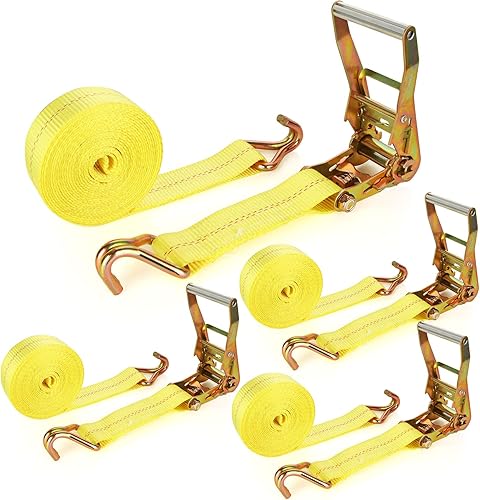
Strap: 4″ wide, 5,400 lb WLL with flat hooks or chain anchors. Quantity: Per FMCSA regulations (see below). Length: 27’–40′. Flatbed straps use heavy-duty ratchets and are designed for professional truckers. They come with flat hooks for stake pockets, chain ends for chain anchors, or wire hooks for D-rings.
FMCSA Tie-Down Count Requirements
For commercial carriers, the number of tie-downs depends on the cargo length and weight:
| Cargo Length | Minimum Tie-Downs |
|---|---|
| 5 feet or less | 2 |
| 5 to 10 feet | 3 |
| Over 10 feet | 4 (plus 1 per additional 10 feet) |
Additionally, the combined WLL of all tie-downs must be at least 50% of the cargo weight. If a single article weighs 5,000 lbs or more, it needs at least 4 tie-downs regardless of length.
Hook Types and When to Use Each
| Hook Type | Anchors To | Best For |
|---|---|---|
| S-hooks | D-rings, chain links, holes | Light cargo, general purpose |
| J-hooks | Trailer frame rails | Open trailers, car haulers |
| Flat hooks | Stake pockets on flatbeds | Commercial flatbed trucking |
| Snap hooks | D-rings, E-track fittings | Enclosed trailers, cargo vans |
| Wire hooks | D-rings, anchor points | Light to medium cargo |
| No hooks (loop end) | Wrapped around bars, rails | Motorcycles, ATVs, irregular shapes |
When NOT to Use Ratchet Straps
Ratchet straps are not the right tool for every job:
- Loads over 20,000 lbs: Use chains with load binders instead. Chain assemblies have higher WLL per unit and don’t degrade from UV exposure.
- Hot cargo (over 180°F): Polyester webbing loses strength above 180°F. Steel coils straight from the mill, hot equipment, or anything near exhaust systems needs chain.
- Sharp-edged cargo without protection: Webbing will cut on steel edges, concrete corners, or rough timber. Use edge protectors or switch to chain.
- Long-term outdoor storage: UV degrades polyester webbing over months. If the load will sit strapped for weeks, use chain or inspect/replace straps regularly.
Related Articles
- How To Tie Down A Car On A Trailer
- How To Tie Down An Atv In A Truck Bed
- How To Tie Down Lumber On A Trailer
- Working Load Limit Vs Breaking Strength
- Best 2-Inch Ratchet Straps
Frequently Asked Questions
What is the difference between WLL and breaking strength?
Working Load Limit (WLL) is the maximum load for safe, repeated use. Breaking strength is the point where the strap physically fails — usually 3x the WLL for polyester webbing. You should always size your straps based on WLL, not breaking strength. The 3:1 safety factor accounts for dynamic forces, knots, wear, and environmental degradation.
Can I use one big strap instead of four smaller ones?
No. Multiple straps provide redundancy and multi-directional restraint. One strap can only hold a load in one axis. If that single strap fails, you have zero restraint. Four straps create a containment system where each strap works with the others. Even if one fails, the remaining three maintain partial control.
Do cam buckle straps work as well as ratchet straps?
Cam buckle straps are adequate for light loads under 500 lbs and for cargo that can be damaged by over-tightening (motorcycles, kayaks, fragile equipment). They are easier to tension precisely but cannot achieve the same clamping force as ratchets. For loads over 500 lbs or anything on a trailer at highway speed, use ratchet straps.
How do I know when a ratchet strap is worn out?
Replace a ratchet strap if you see any of these: cuts or fraying in the webbing, knots tied in the strap (they reduce strength by up to 50%), faded color from UV exposure, a ratchet mechanism that doesn’t lock properly, bent or cracked hooks, or any chemical staining (acids, solvents, bleach). When in doubt, replace it — a new strap costs $10, a failed load costs thousands.
⭐ Recommended Products


As an Amazon Associate, CargoRigging.com earns from qualifying purchases.