
The Challenge of Cylindrical Loads
Coils, pipes, drums, and other cylindrical loads are among the most dangerous cargo types to transport. Their tendency to roll makes them inherently unstable, and when a multi-ton steel coil breaks free, the results are catastrophic. FMCSA dedicates an entire section — 49 CFR §393.120 — specifically to metal coil securement, reflecting the elevated risk.
FMCSA Requirements for Metal Coils (§393.120)
Metal coils weighing 5,000 lbs or more require specific securement methods depending on how the coil is positioned on the trailer:
Eye Vertical (Coil Standing Upright, Eye to the Sky)
| Coil Weight | Method A (Direct Tiedown) | Method B (Direct + Blocking) |
|---|---|---|
| 5,000 – 11,500 lbs | Min 3 tiedowns through eye, 1 over top | 2 tiedowns through eye + timber blocking on 3 sides |
| Over 11,500 lbs | Min 4 tiedowns through eye, 1 over top | 3 tiedowns through eye + timber blocking on 3 sides |
Eye Crosswise (Coil on Side, Eye Left-to-Right)
- Timbers or wedges on both sides to prevent rolling
- At least 1 tiedown over the top from each side
- At least 1 tiedown through the eye from each side (pulling down and outward)
- Blocking at both ends to prevent longitudinal movement
Eye Lengthwise (Coil on Side, Eye Front-to-Back)
- Timbers or wedges on both sides to prevent rolling
- At least 1 tiedown over the top from each side
- At least 2 tiedowns through the eye, one from each side
- Front blocking or headboard contact to prevent forward movement
Pipe and Tube Securement
Pipes, tubes, and bar stock are addressed under the general commodity rules plus specific guidance in §393.118 (dressed lumber and building products) for certain types. Key requirements:
Bundled Pipe
- Bands/strapping: Each bundle must be secured with at least 2 steel bands to prevent individual pipes from shifting within the bundle
- Tiedowns: Minimum 2 tiedowns per bundle, plus 1 additional for every 10 ft of bundle length
- Blocking: Bottom row must be blocked/cradled to prevent rolling. Use V-shaped cradles, timber dunnage, or stake pockets
- Stacking: If stacking bundles, each layer must be blocked/cradled. Upper layers must not exceed the width of the layer below
Individual Large Pipes
- Each pipe must be individually secured if diameter exceeds 18 inches
- Wedges or cradles on both sides to prevent rolling
- Over-the-top tiedowns from each side
- End blocking for longitudinal restraint
Coil Racks and Cradles
Purpose-built coil racks (also called coil bunks, coil cradles, or coil saddles) are the safest method for transporting steel and aluminum coils:
Types of Coil Racks
- Timber cradles: V-shaped hardwood blocks, typically 6×6″ or 8×8″ timbers notched to match coil diameter. Inexpensive but must be inspected for cracks and replaced regularly.
- Steel coil racks: Welded steel frames with adjustable supports. More expensive but reusable for thousands of loads.
- Rubber-lined cradles: Steel cradles with rubber cushioning to prevent surface damage on finished coils (stainless, aluminum, pre-painted).
Chain vs Strap for Coils
| Factor | Chain (Grade 70) | Ratchet Strap |
|---|---|---|
| Edge damage risk | HIGH — chain can nick coil edges | LOW — webbing is soft |
| Strength | HIGH — 4,700 lb WLL (3/8″) | MODERATE — 3,333-5,000 lb WLL (2″-4″) |
| Adjustability | Limited (link-by-link) | Infinite (ratchet mechanism) |
| Corrosion | Resistant (zinc plated) | Strap absorbs water, hardware rusts |
| Temperature | Handles hot coils | Polyester degrades above 194°F |
| Preferred for | Hot-rolled steel coils | Cold-rolled, finished, or aluminum coils |
Industry practice: Use chain with edge protectors for unfinished steel coils. Use straps for finished, painted, or aluminum coils where surface damage is unacceptable.
Drum Securement
55-gallon drums (and similar containers) present unique challenges because they’re often palletized, may contain hazardous materials, and can leak if damaged:
- Palletized drums: Secure the pallet as a unit with stretch wrap + banding, then secure the pallet to the trailer
- Single drums: Use drum cradles or block on 3 sides with wedges. Over-the-top tiedowns with edge protection
- HazMat drums: Must comply with 49 CFR 177 (HazMat transport) in addition to cargo securement rules. Additional placarding and documentation required
- Stacking: Maximum 2 drums high for steel drums, 1 high for plastic drums unless palletized and shrink-wrapped
Blocking and Bracing Materials
Timber Dunnage
- Minimum 4×4″ for loads under 10,000 lbs
- Minimum 6×6″ for loads over 10,000 lbs
- Hardwood (oak, maple) preferred over softwood (pine, spruce) for durability
- Must be free of cracks, rot, and excessive knots
- Nail or screw blocking to the trailer deck to prevent shifting
Rubber Friction Mats
High-friction rubber mats placed under cylindrical loads significantly increase friction coefficient from ~0.3 (steel on steel) to ~0.6 (rubber on steel). This effectively doubles the friction-based restraint, allowing fewer tiedowns in some configurations.
Common Violations and How to Avoid Them
- Insufficient tiedowns through the eye: Many drivers use only over-the-top straps. FMCSA requires tiedowns THROUGH the eye of vertical coils.
- No blocking on bottom row of pipes: Pipes sitting directly on a flat deck with only tiedowns WILL roll. Always use cradles or wedges.
- Using friction alone: A steel coil on a steel deck with no blocking relies entirely on friction (coefficient ~0.3). Any hill, curve, or emergency stop can overcome this.
- Ignoring weight distribution: Heavy coils concentrated on one area of the deck can exceed axle weight ratings even if total weight is within limits.
Common Mistakes to Avoid
Avoiding these common errors can prevent equipment failure, regulatory violations, and serious safety incidents in the field.
- Insufficient Aggregate WLL: FMCSA requires total WLL of all tie-downs to equal at least 50% of cargo weight. For a 40,000 lb load, you need at least 20,000 lbs of total tie-down WLL, which could be 10 ratchet straps rated at 2,000 lbs each.
- Relying Solely on Friction: While friction helps (rubber mats provide coefficient of 0.6-0.7), it cannot be the only securement. FMCSA requires positive securement devices in addition to friction to prevent cargo movement during emergency maneuvers.
- Not Securing Against All Directions: Cargo must be secured against forward, rearward, lateral, and vertical movement. Many drivers only secure against forward movement. Use a combination of direct tie-downs and blocking or bracing to prevent movement in all four directions.
- Wrong Securement for Cylindrical Loads: Coils, pipes, and drums require specialized methods per FMCSA 393.120. They cannot be secured like boxed cargo. Coils must use at minimum one tie-down per coil for eye-up positioning, or specific blocking arrangements for other positions.
- Failing to Re-Check Tie-Downs: FMCSA requires inspection within the first 50 miles and every 3 hours or 150 miles thereafter. Straps loosen due to load settling, vibration, and temperature changes. A tight strap at departure can be dangerously loose after 100 miles.
Frequently Asked Questions
What is the FMCSA requirement for securing coils on a flatbed?
FMCSA 49 CFR 393.120 has specific rules for metal coils. Coils with eyes vertical require a minimum of 3 tie-downs for coils up to 5,000 lbs, 4 tie-downs for 5,000-10,000 lbs, and additional securement for heavier coils. Coils with eyes crosswise or lengthwise have different requirements. All coils require both direct restraint (preventing forward movement) and tiedown restraint (preventing vertical and lateral movement).
What is the best method to prevent cylindrical loads from rolling?
Use timber blocking, wedges, or cradles on both sides of the cylinder to prevent rolling. Chocks should be at least as tall as one-sixth of the pipe diameter. For large pipes, nest them in a pyramid pattern with the bottom row fully blocked. Chain binders work better than ratchet straps for heavy cylinders because chains resist cutting against sharp edges. Edge protectors are mandatory where straps contact the load.
Do I need different securement for paper rolls vs steel coils?
Yes. Paper rolls are lighter but more fragile — they require soft blocking material (cardboard or foam) to prevent surface damage, and lower strap tension to avoid crushing. Steel coils need heavy-duty chain securement and coil racks or A-frame supports. Paper rolls typically ride eyes-vertical with friction mats, while steel coils may be transported eyes-horizontal with cradle supports. Both require anti-rollback devices.
⭐ Recommended Products
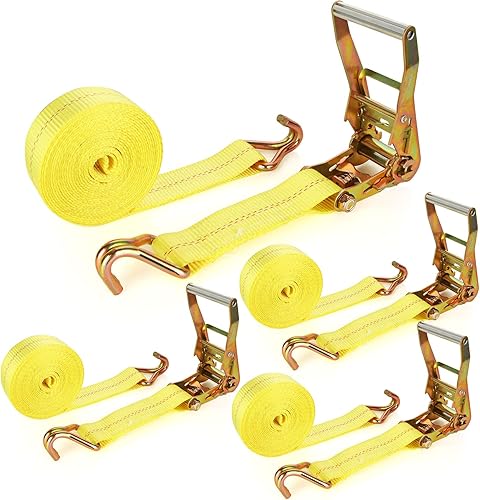
As an Amazon Associate, CargoRigging.com earns from qualifying purchases.