
Why Kayak Tie-Down Requires a Different Approach
Kayaks are long, lightweight, and aerodynamic — which sounds great on the water but creates serious problems on a roof rack at highway speed. A 50-pound kayak at 70 mph generates enough lift force to overcome poorly secured straps, and the smooth hull offers almost zero friction against rack crossbars. Unlike heavy cargo that stays put through sheer weight, kayak securement is all about technique.
Equipment Checklist
| Item | Specification | Why It Matters |
|---|---|---|
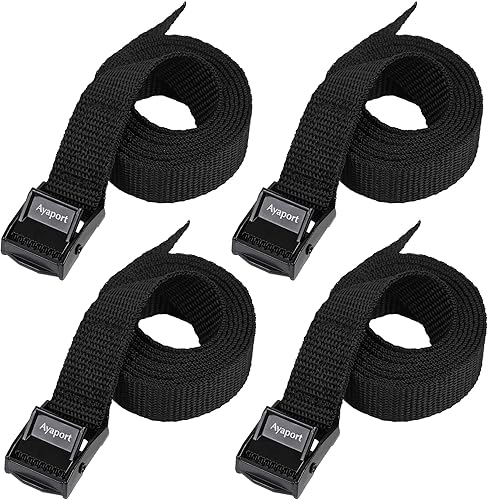
| Cam buckle straps | 1″ wide, 400-600 lb break strength, 12-15 ft long | Cam buckles won’t over-tighten and crush the hull — ratchet straps will |
| Bow and stern lines | 1/4″ rope or ratchet strap, 6-10 ft | Prevents front-to-back shifting during braking and acceleration |
| Roof rack or crossbars | Rated for kayak weight + 2x safety factor | Factory rails alone aren’t enough — you need crossbars |
| Rack pads or pool noodles | Foam padding, full crossbar width | Protects hull from pressure dents and scratches |
| Cockpit cover (optional) | Nylon or neoprene, fitted to model | Prevents wind catching inside cockpit, reduces drag and noise |
Why Cam Buckle Straps, Not Ratchet Straps?
This is the single most important equipment decision. Ratchet straps generate 500-2,000 pounds of tension — far more than a polyethylene kayak hull can handle. Over-tightening a ratchet strap across a kayak will create visible hull deformation (oil canning) within hours. Cam buckle straps max out around 200 pounds of hand tension, which is more than sufficient for a 40-80 pound kayak while protecting the hull.
The only exception: composite (fiberglass or carbon) kayaks with rigid hulls can tolerate ratchet straps if you’re careful. But even then, cam buckles are the safer choice.
Step-by-Step: Loading and Securing
Step 1: Position the Kayak
Place the kayak hull-down (right-side up) centered on your crossbars. The kayak should extend roughly equal distances fore and aft of the crossbars. If you’re carrying a single kayak, center it on the vehicle — offset loads create dangerous crosswind handling.
Tip: If your crossbars are adjustable, spread them as far apart as your rack allows. Wider spacing = more stability. The minimum recommended spacing is 24 inches.
Step 2: Secure the Main Straps (Crossbar Tie-Down)
Run one cam buckle strap over the kayak at each crossbar location. The strap path should be:
- Loop the strap over the kayak hull at the crossbar
- Run both ends down and under the crossbar (not the roof rack rail)
- Bring ends back up and through the cam buckle
- Pull snug — you should be able to slide a flat hand between the strap and hull, but the kayak shouldn’t shift more than 1 inch side to side
Critical: Never wrap straps through the car’s door frame or window. This is a common shortcut that damages weatherstripping, causes leaks, and makes the straps impossible to tension properly.
Step 3: Twist the Straps
After tightening, put 2-3 half-twists in the free strap length between the kayak and the crossbar. This prevents strap flutter — untwisted straps vibrate at highway speed, creating a loud humming noise and accelerating strap wear.
Step 4: Attach Bow and Stern Lines
This is the step most people skip, and the step that prevents the worst-case scenario (kayak flying off at highway speed).
- Bow line: Tie to the kayak’s front carry handle or toggle, run the line down to the front tow hook or bumper anchor point. Angle should be roughly 45 degrees.
- Stern line: Same process at the rear. Use the rear tow hook, hitch receiver, or a dedicated hood/trunk anchor strap.
Tension these lines snug but not guitar-string tight. They’re safety lines, not primary securement — they catch the kayak if a main strap fails.
Step 5: The Shake Test
Grab the kayak at the cockpit rim and try to move it in all directions — forward, backward, side to side, and up. If it shifts more than an inch in any direction, re-tighten. Then walk around the vehicle and check that no strap ends are dangling where they could flap against the paint.
Multiple Kayaks: Stacking Strategies
Carrying 2+ kayaks requires a different approach:
Side-by-Side (Best for 2 Kayaks)
Place both kayaks hull-down with a few inches of gap between them. Run separate straps for each kayak — never strap two kayaks together with one strap, because they’ll shift independently and loosen the shared strap.
J-Cradle / Stacker (Best for 3-4 Kayaks)
J-style cradles hold kayaks on their sides at roughly 45 degrees, allowing you to fit 3-4 kayaks on a standard roof rack. Each kayak gets its own cradle and dedicated strap. Check your rack’s total weight rating — four loaded touring kayaks can exceed 250 pounds, which is near the limit for many factory racks.
Highway Driving Tips
- Speed limit: Stay under 65 mph with a rooftop kayak. Wind load increases exponentially — 70 mph generates 25% more force than 60 mph.
- Crosswinds: Kayaks act as sails. If you feel the vehicle pulling in crosswinds, slow down immediately.
- Re-check at 50 miles: Stop and check all straps after the first 50 miles. Straps stretch slightly as they settle, and hull foam pads compress.
- Gas station checks: Give the kayak a quick shake test every time you stop. Takes 10 seconds.
Common Mistakes That Lead to Lost Kayaks
| Mistake | What Happens | Fix |
|---|---|---|
| Using ratchet straps | Hull deformation, then sudden strap loosening | Switch to cam buckle straps |
| No bow/stern lines | Kayak slides forward during hard braking | Always use front and rear safety lines |
| Straps through door frame | Damaged weatherstripping, water leaks | Strap around crossbars only |
| Single strap | Kayak pivots around one point, slides off | Minimum 2 straps at each crossbar |
| Cockpit facing forward | Wind fills cockpit like a parachute | Face cockpit rearward or use a cockpit cover |
Rack Types Compared
Bare crossbars with padding: Cheapest option. Works fine for occasional trips under 100 miles. Use pool noodles or foam blocks as padding. Best for recreational kayaks under 12 feet.
J-cradles: $60-150 per pair. Hold kayaks on edge, saving roof space. Best for multiple kayaks or vehicles with narrow roofs. Slight increase in wind resistance due to the exposed hull profile.
Saddle-style cradles: $80-200 per pair. Kayak sits hull-down in contoured cradles. Most stable option, lowest wind profile. Best for long highway trips and expensive composite kayaks.
Rollers: $100-250. Rear-loading rollers let you slide the kayak onto the roof from the back of the vehicle without lifting. Essential if you’re loading solo or have a tall vehicle (SUV, truck).
Frequently Asked Questions
Can I use bungee cords instead of straps?
No. Bungee cords stretch under load and have no positive locking mechanism. They’re fine for holding a cockpit cover in place, but never for securing a kayak to a roof rack. A bungee cord that seems tight in your driveway will stretch enough at highway speed to let the kayak shift and eventually fly off.
Do I need bow and stern lines for short trips?
Yes. Most kayak-off-the-roof incidents happen within 20 miles of the launch point, often because people skip the safety lines for “quick trips.” The lines take 60 seconds to attach. Your kayak costs $500-3,000. The car behind you doesn’t deserve a kayak through their windshield.
How tight should the straps be?
Snug enough that the kayak doesn’t shift more than 1 inch when you push it sideways. You should be able to slide a flat hand between the strap and the hull. If you can’t fit your hand, it’s too tight and you risk hull damage. If the kayak moves 2+ inches, it’s too loose.
Can I drive through a car wash with a kayak on the roof?
No. Automatic car washes will catch on straps, cradles, and the kayak itself. Hand-wash or touchless only.
What about rain — do I need to cover the kayak?
No cover needed for the exterior. But use a cockpit cover to prevent the cockpit from filling with rainwater, which adds weight and changes the kayak’s center of gravity on the rack.
My kayak is longer than my vehicle. Is that legal?
In most US states, cargo can extend up to 4 feet beyond the rear bumper without a flag or light, and up to 3 feet beyond the front. Kayaks over 14 feet on a compact car will typically overhang the rear — tie a red flag or cloth to the stern if it extends more than 3 feet past the bumper. Check your state’s specific overhang laws.
Related Articles
⭐ Recommended Products
As an Amazon Associate, CargoRigging.com earns from qualifying purchases.